Sunday, January 9, 2011

Cough Medicine

I have been sick for the past week, I think it was the flu. I had a flu shot in the Fall but that only protects against previous versions of the flu. The weather in Taiwan has been unseasonably cold, so lots of people have coughs, fevers, ... The most annoying part has been the cough, I tried almost every "over the counter" medicine but none of them seemed to have an effect. Here's by current collection:


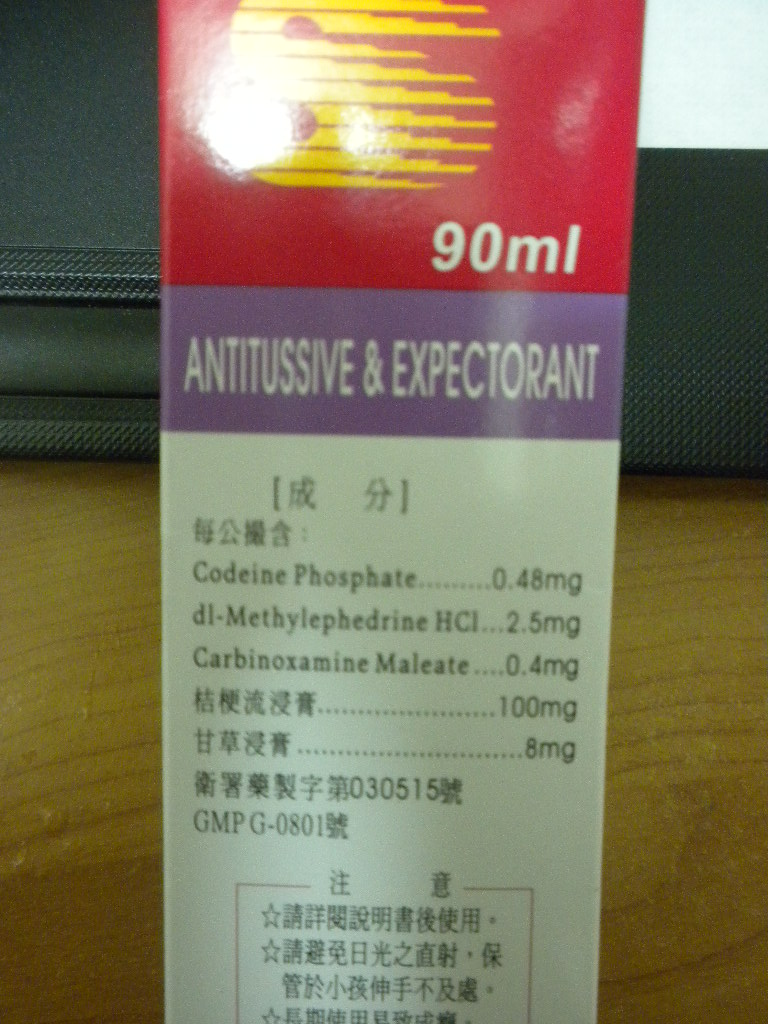
None of them seemed to control the cough, so I went to a pharmacist and asked for his recommendation. He quickly pointed me to this medicine which I think comes from Japan.

Why did this one worked when all the others were ineffective in stopping the cough? The magic ingredient is right of the box:

Codiene can stop the cough, being a component of opium is why it is not available in the US. I remember in the 1970s, kids in Minnesota would drive to some backwater drugstore in South Dakota and clean out the shelves of cough medicine with codiene. Of course, it wasn't to cure a cough but to get high. I think sometime in the 70s the US stopped using codiene in "over the counter" medicine. I know in Canada some codiene products are still available. And in Japan it seems OK too. I recommend codiene, but only for medicinal uses.

Friday, January 7, 2011

National Museum of Taiwan Literature

As part of the field trip to the Confucius Temple we also got a tour of the National Museum of Taiwan Literature. Of course, most of the writing done by Taiwanese authors is in Chinese but some of the works have been translated into English. Most of the famous translations are in the Cheng Da library and I have read most of them. There are my recommendations:

"A Taste of Apples" by Huang Chua-ming, stories about adapting to the modern world. This is the best, very funny.


"Rose, Rose, I Love You" by Wang Chein-ho, a story of Taiwanese-American relations during the VietNam war. a little raw, funny

"A Thousand Moons on a Thousand Rivers", by Hsiao Li-hung about simple peasant life in Taiwan before modernization

"Wintry Night" by Li Qiao good historical novel of Taiwan from preJapanese time to after WWII.


Most of them have been published in the "Modern Chinese Literature From Taiwan" series from the Columbia University Press. I know the King County Library has many of them.

Thursday, January 6, 2011

Return to the Confucius Temple

Yesterday the Chinese Language Center sponsored a field trip to the Confucius Temple in Tainan. I had been to the Temple many times and had reads some descriptions but this time we had an English speaking tour guide. It was like seeing something familiar but this time with "new eyes". She had all kinds of details and stories and background that I had not known before.

Here are some of my new found information.

Here is the Japanese built Fire Station near the Confucius Temple, before I though the 119 was the street address but it turns out that in all of Asia 119 is the equivalent of 911 on the telephone. The students from Korea and Japan said it was so in their countries too.

The Confucius Temple in Taiwan was one of 18 official highest level temples built during the Qing Dynatsy. It is the only one still in existence because the other 17 were destroyed during Mao Zedong's "Cultural Revolution". It's ironic that Communist China is now trying to expand it's "soft power" around the world with "Confucius Institutes" teaching the Chinese language and Confucius principles.

Below is the original outside gate for the Confucius Temple, it follows the standard Chinese model of 4 pillars and 3 openings. If it doesn't have these two requisites, it's not a Chinese gate.


Here is the inside gate for the Confucius Temple notice it has the same 4 pillars(2 on either side are off camera) and 3 openings. In this case everyone enters from the outside openings as the middle opening is reserved for the Emperor.
Through out the Temple there are these stella of proclamations from the Emperor. This one is from the early Qing Dynasty and in Chinese on one side it said everyone should stop here to worship Confucius. The other side says the same thing but this time it is written Mongolian script. The Qing Dynasty was not actually Chinese but they conquered the Chinese in 1644. By the time they were overthrown in 1911 they were as much Chinese as those they had conquered.

When the temple was built the builders left this stella behind. It is a "blueprint" in stone of what the Temple was to look like. With all the typhoons and earthquakes in Taiwan the Temple would have to be rebuilt from time to time and this was the layout of the temple for future reconstruction. Not much chance for modifications.

Wednesday, January 5, 2011

The three R's of recycling

The three R's of recycling are:

reduce
reuse
recycle

I think the Taiwanese are great at all of them but the second one must get special mention. I like how they use old CDs as reflectors on their bicycles like this one:


But for special mention I have to show this one:


The display is all made of CDs on the wall of church and I'm sure it means:

"Jesus loves you".

The church entrance is next to the display. A more traditional display.

It is Taiwan Lutheran church.

Monday, January 3, 2011

Soft Shell Crabs

While in Taipei this past week I heard an interesting story about soft shell crabs while eating one. I think all crustaceans with their exoskeleton(shell) grow by "molting", they shed their shell and then grow a new larger one from the exposed inside. Between when they shed and the new shell developed they are vunerable and tasty. There are about 4 days in the "window of opportunity".


Below is a pictures of the blue crabs which are the soft shell crabs in the US. The soft shell crabs in Taiwan are a different species but the same principle.

I also think all crustaceans also have the ability to regrown arms that are cut off, this is called "regeneration". (Some salamanders also have this ability, but frogs and toads do not.)

Because there is only a 4 day window for soft shell crabs once they molt, they can't be predictably listed on the menu.  But it turns out that cutting off an arm triggers the molting process so the "window of opportunity" can be manipulated to some extent. So crabs can be caught before their time to molt and then be induced to molt by amputation.

To those that think this is cruel, I have to points:

1. A caught crab will be eaten one way or another.
2. Is this any less manipulative than how we treat farm animals?

Sunday, January 2, 2011

The ROC is 100 years old

This weekend I went to Taipei, here is the bus ticket stub:

From the ticket you can see that it cost 400NT which is about $13US. Not too bad for a trip of 167 miles(270 km). But it does take 4 hours when traffic is good. The other interesting detail is that the date is January 1st but the year is 100! not 2011. How did that happen?

 Sometimes in Taiwan the year is expressed from the founding of the Republic of China(ROC) which was in 1911. (It's so Western to date everything from the birth of Christ.) That was the year the Qing Dynasty was overthrown and China be came a republic. Here is a time line of the events and how they concern Taiwan.

1895 The Qing Dynasty loses a war with Japan and cedes Taiwan to Japan
1911 Sun Yat Sun and his followers overthrow the Qing Dynasty, establishes ROC
1925 Sun Yat-sen dies and Chiang Kai-shek takes takes over the ruling party
          of  the ROC, the KMT
1945 Japan loses the "War of the Pacific" and surrenders Taiwan to the ROC
1949 Mao Zedong and Communists defeat the ROC forces on the Chinese     
         mainland and the ROC retreats to Taiwan. The communist government on
         the mainland is called the Peoples Republic of China(PRC).
1975 Chiang Kai-shek dies
1976 MaoZedong dies
1987 Martial law lifted in Taiwan
2011 100 years of the Republic of China(ROC)

In the future, I'll add detail and try not to add too much commentary(this whole sequence of events is nuanced).


Saturday, January 1, 2011

My classes this time

Last time I was at the National Cheng Kung University Chinese Language Center, I took 2 semester of Chinese in the small class setting. That was 10 hours per week in a class of about 12 students. An additional 5 hours per week was spent in classes on optional classes like calligraphy, Chinese music, useful phrases, pronunciation and grammar.

This time, I switched to 1 on 1 tutors for the 10 hours of classes. So I have two teachers, one twice a week for 2 hours and the other 3 times a week for 2 hours. In the classroom it was easier to hide from the teacher but in the 1 on 1 tutoring there is nowhere to hide. In just one week I think I've made more progress than in the classroom experience for similar amount of time.(Duh!) For me, class size really has made a difference. The cost is almost double for 1 on 1 tutoring versus classes.

This time the additional 5 hours of instruction is divided into

2 hours in pronunciation
1 hour in grammar
2 hours in Taijiquan

Taijiquan is the traditional Chinese form of exercise.  For fun

Here is the building on campus housing the Chinese Language Center.


Here are the other departments that share the building.

 
Here is the room for 1 on 1 tutoring, a tutor and student per desk.